How Much Tax Do You Pay If You Withdraw Early From TSP?
An early TSP withdrawal has three costs: ordinary income tax, a 10% penalty if no exception applies, and the growth you lose by taking the money out. The size of each cost depends on your age, your bracket, and your TSP account type. Run your own numbers on the TSP early withdrawal calculator before you decide.
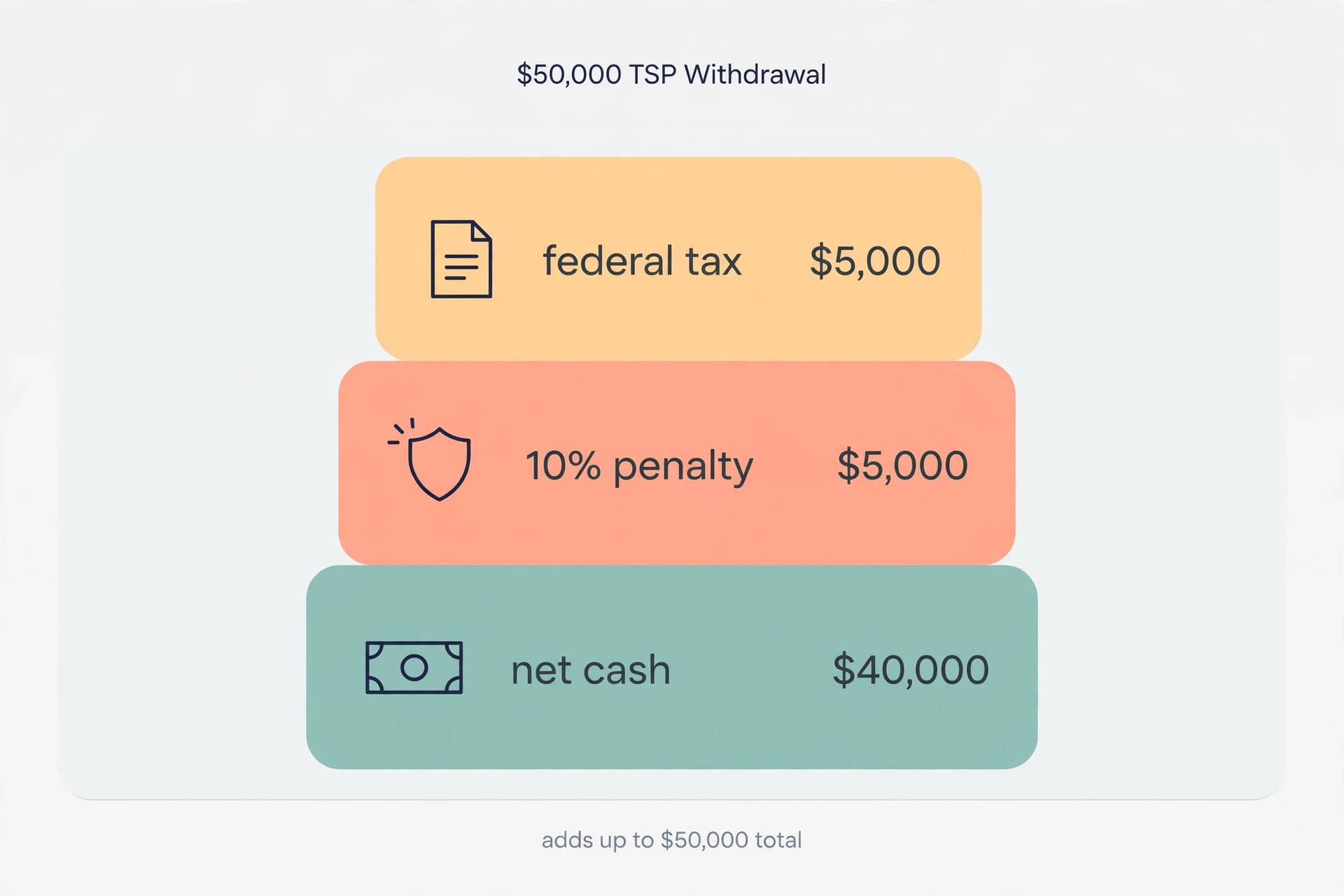
Direct answer: If you withdraw early from a Traditional TSP, you pay ordinary income tax at your marginal rate. You also pay a 10% early withdrawal penalty on the taxable part when you are under age 59 and a half and no exception applies, according to IRS Topic 558 and IRS Publication 575. On an illustrative worked example, a $50,000 withdrawal at age 58 with no age 55 exception costs $19,500 in total. It leaves $30,500.
Key Takeaways
- Early means before age 59 and a half for the 10% penalty, unless an exception applies.
- The age 55 separation rule can remove the penalty entirely, and it is worth $5,000 on the $50,000 worked example.
- The TSP withholds 20% of an eligible rollover distribution paid to you, per tsp.gov, but that is not your final bill.
- Lost growth is a real cost too, and it depends on the return you assume, so the calculator lets you set your own growth rate.
What are the three costs of an early TSP withdrawal?
Ordinary income tax, the 10% penalty if it applies, and the future growth the money would have earned if it had stayed invested.
Federal tax applies because a Traditional TSP withdrawal counts as ordinary income. State tax applies where your state taxes it. The penalty is 10% of the taxable part when you are under 59 and a half and no exception applies, per IRS Topic 558.
Lost growth is the hardest cost to see, because it never appears on a tax form. No official growth rate exists, so this post gives no growth figure. The calculator uses a 6% annual return you can change. It labels that return plainly as an assumption you can edit, not an official figure.
| Cost | How it is worked out | Source |
|---|---|---|
| Federal tax | Taxable part times your marginal rate | IRS |
| 10% penalty | 10% of the taxable part, under 59 and a half | IRS Topic 558 |
| State tax | Depends on your state | State tax agency |
| Lost growth | A return you set yourself, 6% a year by default, and you can change it | Calculator assumption |
How much is the penalty on a $50,000 withdrawal?
The penalty is $5,000, which is 10% of $50,000, when no exception applies.
A sample worked example gives the full picture. Federal tax at 24% is $12,000. State tax at 5% is $2,500. The 10% penalty is $5,000. That gives $19,500 total and $30,500 net. The math checks out, and the 10% penalty follows IRS Topic 558. But the 24% and 5% rates are sample rates, so treat them as an example and check your own bracket with the calculator.
If the age 55 separation rule applies, the penalty is $0 and the total falls to $14,500, leaving $35,500. The difference is exactly the $5,000 penalty, which is why the separation year matters so much.
What if you are already 59 and a half or older?
The 10% penalty no longer applies, but ordinary income tax still does.
Age 59 and a half removes the penalty, not the tax. A Traditional TSP withdrawal after that age is still taxed as ordinary income, and the 20% withholding still applies to an eligible rollover distribution paid to you, per tsp.gov.
A qualified Roth TSP withdrawal can be tax free, but the Roth 5-year rule and the treatment of Roth earnings are covered in our Roth posts. Check the exact conditions on tsp.gov Roth TSP pages and IRS Publication 575.
Frequently asked questions
How much tax do I pay if I withdraw early from TSP?
You pay ordinary income tax at your marginal rate plus a 10% penalty on the taxable part if you are under 59 and a half and no exception applies, per IRS Topic 558. On the illustrative worked example, $50,000 at age 58 costs $19,500 and leaves $30,500.
How much tax and penalty will I pay on an early TSP withdrawal?
It depends on your bracket, your state, and your age. The $50,000 worked example gives $12,000 federal tax, $2,500 state tax, and a $5,000 penalty, a total of $19,500, when no exception applies.
How to use the TSP early withdrawal calculator
Open the TSP early withdrawal calculator and enter your withdrawal amount with your age and Traditional TSP. Then tick the box that matches your separation year so the age 55 test runs on your own dates. The result lists the three costs from this post side by side: federal tax, the 10% penalty, and the cash you keep. The $50,000 example comes out at $19,500 of cost and $30,500 kept when no exception applies.
Move the age to 59 and a half in the calculator and the penalty line drops to zero while the tax stays, which separates the cost you can avoid by waiting from the cost you cannot.
If a loan would let you keep the money invested instead of paying the penalty, weigh it on the TSP loan calculator.
Read more in the same cluster: How to Avoid the 10% Penalty on a TSP Withdrawal, Legally.
Sources
- IRS Topic 558, Additional Tax on Early Distributions From Retirement Plans Other Than IRAs.
- IRS Publication 575, Pension and Annuity Income.
- tsp.gov, Changes to Tax Rules About TSP Payments (20% mandatory withholding).
Disclaimer: Estimates only, not financial advice. Confirm the three costs for your own withdrawal on tsp.gov and IRS guidance, or with a qualified tax adviser, before you act.
Last verified: 16 November 2026