What Happens If Your State Pension Is Above the Personal Allowance?
If your State Pension rises above the Personal Allowance, the part above the allowance becomes taxable income. That does not always mean you pay tax straight away. This post explains what happens when your State Pension goes above the Personal Allowance. Use the State Pension Breach Year Calculator to find the year your own pension crosses the allowance and the year tax actually starts for you.
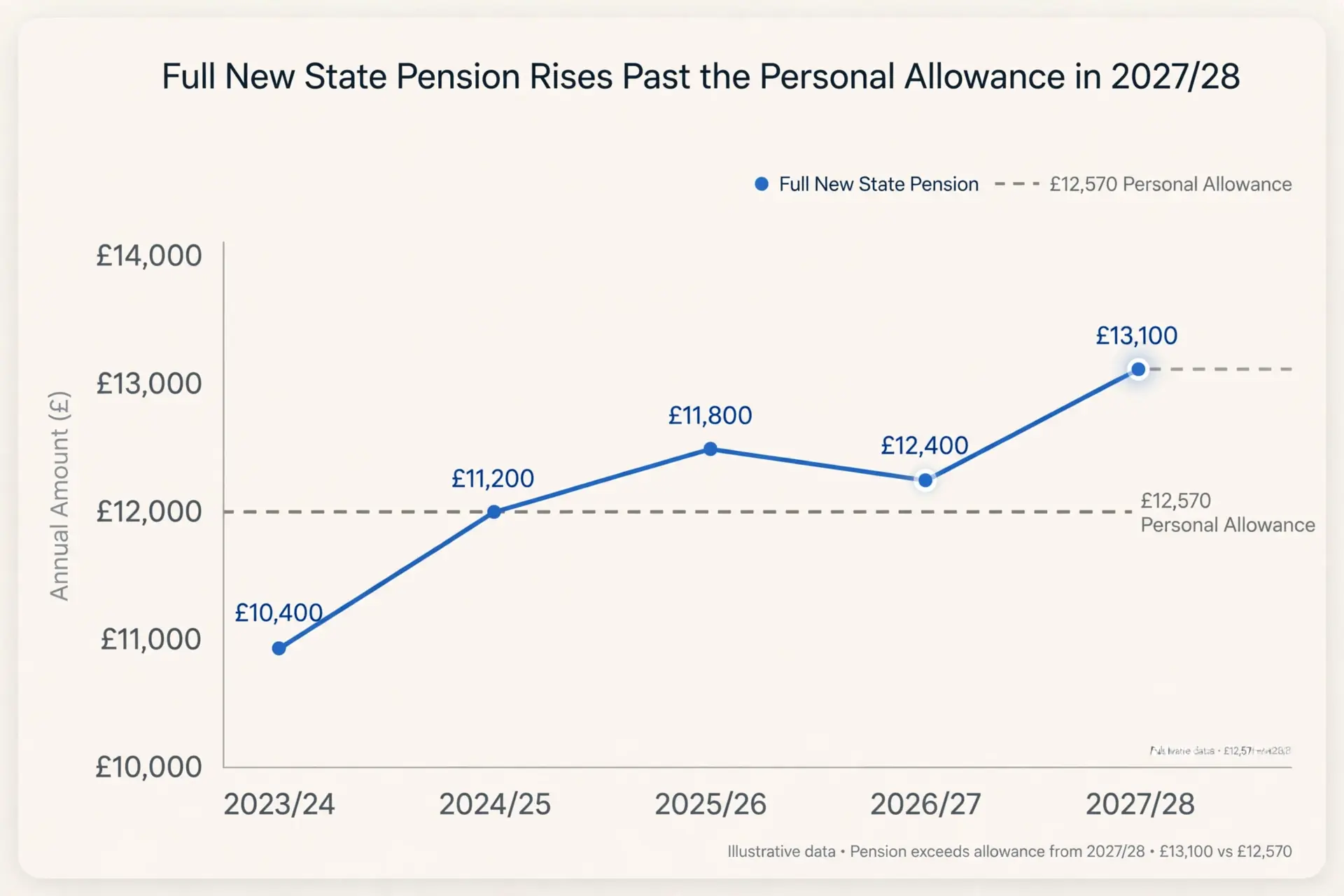
Direct answer: In 2027/28 the full new State Pension is £13,036.40 a year, which is £466.40 above the frozen £12,570 Personal Allowance, according to GOV.UK State Pension rates. For state-pension-only income you still pay no tax in 2027/28, because the Pension Tax Allowance cancels the tax, so tax actually starts in 2030/31. The Pension Tax Allowance is confirmed in House of Commons Library briefing CBP-10250, 13 November 2026, which puts the government estimate at around 290,000 pensioners taken out of tax in 2027/28.
Key Takeaways
- The Personal Allowance is £12,570 and it is frozen until April 2031, according to GOV.UK.
- The full new State Pension is £12,547.60 a year in 2026/27, which is £22.40 below the allowance, so no tax is due on state-pension-only income.
- In 2027/28 the full new State Pension is £13,036.40 a year, which is £466.40 above the allowance. That year is the breach year.
- The Pension Tax Allowance cancels the tax for state-pension-only income until 2030/31, so the breach year is not the year tax starts.
- Other income can push you past the Pension Tax Allowance taper sooner, so check your own total income.
What does it mean when your State Pension goes above the Personal Allowance?
It means the amount above £12,570 counts as taxable income. The State Pension is taxable income, but it is not taxed at source, according to GOV.UK and LITRG guidance. The Department for Work and Pensions pays it gross, with nothing taken off for tax.
The part above the allowance is added to your other taxable income for the year. If the State Pension is your only income, the amount above the allowance is small at first. In 2027/28 it is £466.40 for someone on the full new State Pension.
| Tax year | Full new State Pension | Personal Allowance | Headroom or excess |
|---|---|---|---|
| 2026/27 | £12,547.60 a year | £12,570 | £22.40 below |
| 2027/28 | £13,036.40 a year | £12,570 | £466.40 above |
How much tax would you owe without the Pension Tax Allowance?
You would owe about £93.28 in 2027/28 on state-pension-only income. That figure comes from the 20% basic rate on the £466.40 excess, as worked out from the GOV.UK HM Treasury figures. The basic rate is 20% on income up to £50,270, according to GOV.UK.
That £93.28 is the tax before the Pension Tax Allowance is applied. It is not the tax you actually pay. The Pension Tax Allowance cancels it for state-pension-only income. The £93.28 is a worked figure, not an HMRC-published figure. Its inputs are verified: the DWP proposed rate of £250.70 a week gives £13,036.40 a year, GOV.UK gives the £12,570 Personal Allowance and the 20% basic rate, and 20% of the £466.40 excess is £93.28 by arithmetic.
Why do you still pay no tax in 2027/28?
You still pay no tax thanks to the Pension Tax Allowance. The 2026 Autumn Budget of 28 October 2026 announced this new allowance for 2027/28 to 2029/30, with legislation to be introduced in Finance Bill 2026-27, according to GOV.UK HM Treasury. It is worth up to £94 and it is automatic, with no claim needed.
The allowance tapers by £1 for every £3 of income above £13,036.40, and it is gone at £13,316.24. Budget 2026 Annex A publishes £13,319 as the rounded end of the taper, because Annex A rounds the pension to £13,037 and the allowance to £94. For state-pension-only income the full allowance applies, so the tax is cancelled in full. Those allowance figures follow GOV.UK HM Treasury, which sets the maximum allowance at 20% of the gap between the Personal Allowance and the full new State Pension.
What happens if you have other income as well?
Other income can change the answer. A private pension, part-time earnings, or taxable savings interest all count toward your total income. If your total income rises above £13,036.40, the Pension Tax Allowance starts to taper away.
Once the allowance has tapered away, tax starts earlier than 2030/31. That is why a single national date is not enough. You need to check your own income, your own pension, and the taper together. See also our post on does the State Pension affect your Personal Allowance for how the pension uses up the allowance first.
Frequently asked questions
What happens if my State Pension is above the Personal Allowance?
The amount above the £12,570 Personal Allowance counts as taxable income. In 2027/28 the full new State Pension is £13,036.40 a year, £466.40 above the allowance. For state-pension-only income the Pension Tax Allowance cancels the tax, so tax actually starts in 2030/31.
How much tax would I owe in 2027/28 without the Pension Tax Allowance?
About £93.28, which is 20% basic rate tax on the £466.40 excess. This is a worked figure from verified GOV.UK and DWP inputs, and the Pension Tax Allowance cancels it for state-pension-only income.
Does the State Pension count towards the Personal Allowance?
Yes. The State Pension is taxable income and it uses up your Personal Allowance first, according to GOV.UK and LITRG.
How to use the State Pension Breach Year Calculator
Open the State Pension Breach Year Calculator and put in your weekly or annual State Pension together with any other taxable income, because the crossing point depends on your own numbers rather than the full rate. The answer splits into three parts: the year your pension passes the allowance, the tax that would be due before the Pension Tax Allowance, and the year tax actually starts once the allowance is applied.
The benefits are simple. Seeing the breach year and the tax-start year side by side stops the headline dates from misleading you, since the two dates sit three years apart for state-pension-only income. A year-by-year table from 2026/27 to 2030/31 comes with the result, so you can watch the gap above the allowance widen over time. It is free to use, with no email gate and no sign-up.
Sources
- GOV.UK, State Pension rates and income tax allowances: full new State Pension £241.30 a week in 2026/27 and £250.70 a week in 2027/28, Personal Allowance £12,570.
- DWP, proposed benefit and pension rates 2027 to 2028, 11 November 2026: full new State Pension £250.70 a week, up 3.9% from £241.30.
- GOV.UK and LITRG: the State Pension is taxable income but is not taxed at source.
- GOV.UK HM Treasury, 28 October 2026 Budget: Pension Tax Allowance figures and the £93.28 worked tax figure.
- House of Commons Library briefing CBP-10250, 13 November 2026, by Antony Seely: Taxation of state pension. Confirms the Pension Tax Allowance and the government estimate of around 290,000 pensioners taken out of tax in 2027/28.
Disclaimer: Estimates only, not financial advice. Verify with HMRC guidance or a qualified tax adviser.
Last verified: 16 November 2026