How Much Is Taxed on a 401(k) Early Withdrawal?
The tax on an early 401(k) withdrawal is not one number. It is income tax plus a penalty, and the income tax part depends on your bracket. Use the 401(k) Early Withdrawal Calculator to work out the full bill on your own amount.
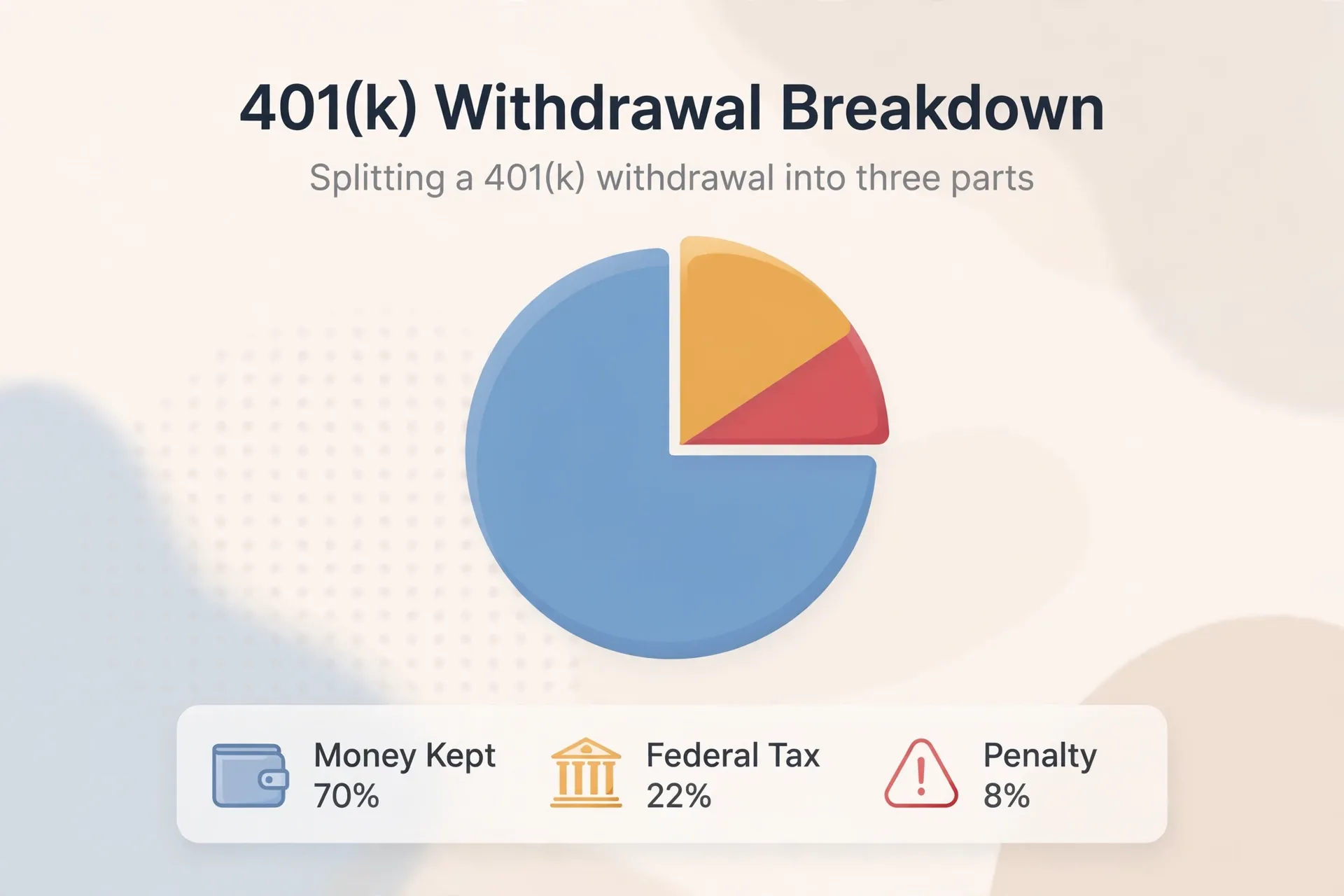
Direct answer: An early withdrawal from a traditional 401(k) is taxed as ordinary income, and it usually also carries a 10% additional tax under IRC 72(t) if you are under age 59 and one half, according to IRS retirement plan distribution guidance. As an illustration, a $20,000 withdrawal at a 22% federal marginal rate carried $4,400 of federal tax plus a $2,000 penalty, leaving $13,600.
Key Takeaways
The short version: income tax and the 10% penalty are two separate charges, and your bracket decides the tax part.
- A traditional 401(k) withdrawal counts as ordinary income, according to the IRS.
- The 10% additional tax applies before age 59 and one half, according to the IRS.
- Your tax bracket decides how much income tax you pay, so two people can pay different tax on the same withdrawal.
- The federal tax brackets are the 2026 IRS figures, with seven rates from 10% to 37%, according to IRS Revenue Procedure 2025-32.
How is the tax worked out?
Add the withdrawal to your taxable income for the year, then apply your tax bracket, then add the 10% penalty if you are under 59 and one half.
This is why there is no single tax rate for 401(k) withdrawals. The withdrawal joins your salary and other income, and the total decides your bracket. A larger withdrawal can push part of itself into a higher bracket.
The federal brackets the calculator needs are the 2026 IRS figures: seven rates from 10% to 37%, with the 22% rate starting above $50,400 of taxable income for a single filer and above $100,800 for married couples filing jointly, according to IRS Revenue Procedure 2025-32. Do not use a bracket from memory.
What does the $20,000 example show?
As an illustration, a $20,000 withdrawal at age 45 cost $4,400 in federal tax and $2,000 in penalty, leaving $13,600.
The inputs were a $20,000 withdrawal, age 45, Single, a $60,000 salary and retirement at 65. The 22% rate is the 2026 federal marginal rate for that income under IRS Rev. Proc. 2025-32, and the growth lost over 20 years at a 6% return came to $44,143. Here are the steps. Start with $20,000. Grow it at 6% a year for 20 years. That is $20,000 times 1.06 to the power of 20, which gives $64,143. Then take off the $20,000 you started with. The growth lost is $64,143 minus $20,000, which is $44,143. The 6% return is an assumption, not an IRS figure.
The example is useful because it shows the shape of the bill: the tax was more than double the penalty. For most people, the income tax is the bigger half of the cost.
Does state tax apply too?
Yes, in most states, and the rate depends on where you live.
State tax is charged on top of federal tax in states that tax retirement income. A few states have no state income tax, and some treat retirement withdrawals differently. State tax is estimated at your state’s top marginal rate, from the Tax Foundation 2026 state rates table. Your actual state tax depends on your total income, deductions and your state’s brackets.
This is why the calculator asks for your state. The same withdrawal can cost a different total in California than in Texas or Florida, because state tax rules differ.
What is the 20% withholding people talk about?
The 20% figure people quote is about withholding, not the penalty, and it is not the same as your final tax bill.
When money is paid out, an amount may be withheld and sent to the IRS in advance. That withheld amount is a prepayment, not the final tax. Your real bill is worked out when you file your return, and it can be higher or lower than what was withheld.
The 20% applies to eligible rollover distributions paid directly to you, and you cannot choose a lower rate. It does not apply to distributions that cannot be rolled over, such as hardship withdrawals and required minimum distributions, which default to 10% withholding, according to IRS Publication 575 and IRS pensions and annuity withholding guidance.
Frequently asked questions
Short answers to the questions readers ask most about the tax on an early withdrawal.
How much tax will I pay on an early 401(k) withdrawal?
It depends on your tax bracket, because the withdrawal counts as ordinary income, according to the IRS. On top of that, a 10% additional tax usually applies before age 59 and one half. As an illustration, a $20,000 withdrawal at a 22% federal marginal rate cost $4,400 in tax plus a $2,000 penalty.
Is the 20% withholding the same as the tax?
No. Withholding is money taken in advance, and your final tax bill is worked out when you file. The IRS requires 20% withholding on an eligible rollover distribution paid directly to you, and a direct rollover avoids it, according to IRS Publication 575.
Do I pay state tax on a 401(k) withdrawal?
Usually yes, if your state taxes retirement income. State tax is estimated at your state’s top marginal rate, from the Tax Foundation 2026 state rates table; check your state tax authority for your exact bill.
How to use the 401(k) early withdrawal calculator
Work out the tax on your own withdrawal with the free 401(k) early withdrawal calculator, with no email needed.
Enter your withdrawal amount, your age, your filing status and your state, and the calculator applies the 2026 IRS brackets to your numbers.
The results panel splits the bill into federal tax, state tax, the 10% penalty and the net amount you keep, so you can see which part is biggest.
Change only the withdrawal amount and watch the federal tax line move, because that single change shows how much of the bill is tax and how much is penalty.
Run your own numbers in the 401(k) Early Withdrawal Calculator. Enter your withdrawal amount and your state, then change the amount and watch the tax and the net amount move. That is the fastest way to see what the withdrawal really costs you.
Related reading in this cluster: How Much Do You Get Penalized for Taking Money Out of Your 401(k)?.
Disclaimer: This post is for education only. All figures are estimates only, not financial advice. Tax rules change, and your plan has its own rules, so check the IRS guidance or talk to a qualified tax adviser before you withdraw.
Sources
These are the sources used in this post.
- IRS retirement plan distribution guidance.
- 26 USC 72(t), the Internal Revenue Code section that sets the 10% additional tax on early distributions and lists its exceptions.
- IRS Revenue Procedure 2025-32, tax year 2026 inflation adjustments (federal brackets).
- IRS Publication 575, Pension and Annuity Income (20% withholding on eligible rollover distributions).
Last verified: 16 November 2026