How to Calculate Your Tapered Annual Allowance, Step by Step
If your pay is high, your pension annual allowance may not be the full £60,000. Tapering can cut it down, and the only way to know your real limit is to work through two income figures first. This guide shows each step in plain English, with the official method from GOV.UK. If you want the answer without doing the maths by hand, use the Tapered Pension Allowance Calculator and it will work it out for you in seconds.
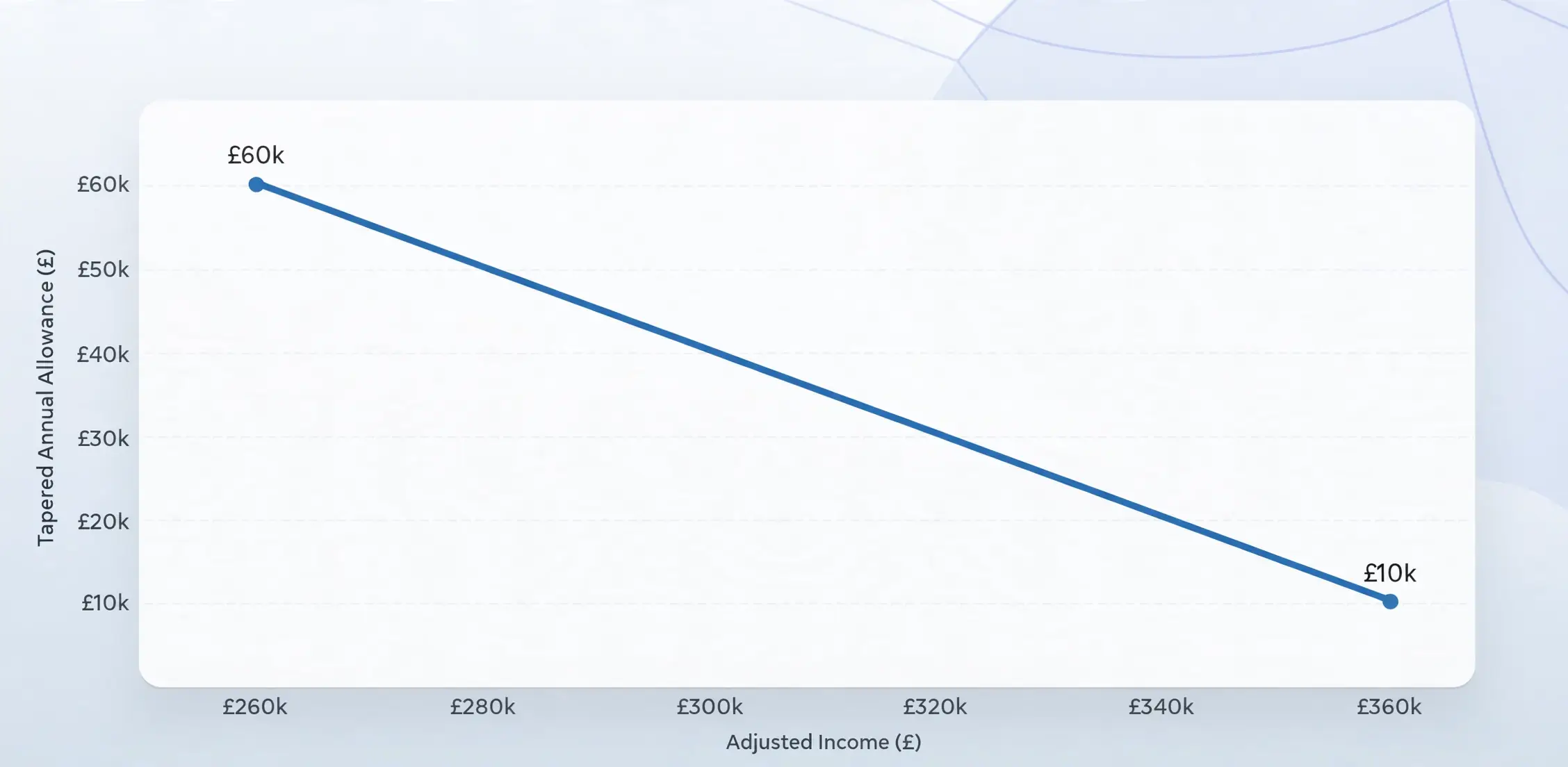
Direct answer: To calculate your tapered annual allowance, first work out your threshold income and your adjusted income using the GOV.UK method. Tapering applies only if your threshold income is over £200,000 and your adjusted income is over £260,000, according to GOV.UK. Your allowance then falls by £1 for every £2 of adjusted income over £260,000, down to a £10,000 minimum, according to GOV.UK.
Key Takeaways
The short answer is that you need two income figures, then one simple taper sum.
- The standard annual allowance is £60,000, according to HMRC and GOV.UK.
- Tapering applies only if both gates are passed: threshold income over £200,000 and adjusted income over £260,000, according to GOV.UK.
- The allowance falls by £1 for every £2 of adjusted income over £260,000, down to a £10,000 minimum, according to GOV.UK.
- Your available allowance is your reduced allowance plus any unused allowance from the previous 3 tax years, according to GOV.UK.
- If your pension savings are more than your available allowance, the excess is added to your taxable income, according to GOV.UK.
How do I calculate my tapered annual allowance?
You calculate it in four steps: work out your net income, work out your pension savings, work out threshold income and adjusted income, then apply the taper.
GOV.UK sets out the method in its guidance “Work out your reduced (tapered) annual allowance”. The four steps are net income, pension savings, threshold income and adjusted income. You need all four before the taper sum means anything, because the taper only starts when both income gates are passed.
Start by gathering your figures for the tax year. You need your total taxable income, your pension contributions, your employer pension contributions, and your pension savings. Your pension scheme should send you an annual pension savings statement, and GOV.UK says you can ask your pension administrators for it if you have not received one.
What two income figures do I need first?
You need threshold income and adjusted income, and they are not the same number.
Threshold income is broadly your net taxable income minus your own gross pension contributions. GOV.UK explains the full method: start with your net income for the tax year, then deduct the gross amount of your pension contributions to schemes where you had relief at source, deduct any lump sum death benefits received, and add back any reduction of employment income through salary sacrifice or flexible remuneration arrangements made after 8 July 2015.
Adjusted income is broadly your total taxable income plus all personal and employer pension contributions. GOV.UK explains the full method: start with your net income, add back pension savings where tax relief was given, and add the pension savings your employer made for you.
The difference matters. Employer contributions count in adjusted income but not in threshold income. That is why a person can have a high adjusted income but still escape tapering if their threshold income is £200,000 or less.
How does the taper maths work?
The taper maths is one subtraction and one division, once you know your adjusted income.
If your adjusted income is £260,000 or less, there is no taper. If it is over £260,000, take the amount over £260,000, divide it by 2, and take that away from £60,000. The result cannot fall below £10,000. GOV.UK states the rule as £1 lost for every £2 of adjusted income over £260,000, with a £10,000 minimum.
| Adjusted income | Allowance lost | Your tapered allowance |
|---|---|---|
| £260,000 | £0 | £60,000 |
| £280,000 | £10,000 | £50,000 |
| £300,000 | £20,000 | £40,000 |
| £320,000 | £30,000 | £30,000 |
| £340,000 | £40,000 | £20,000 |
| £360,000 or more | £50,000 | £10,000 |
This table is the £1 for £2 rule worked out step by step, and it was verified against the GOV.UK taper page on 14 November 2026. For example, at £300,000 of adjusted income you are £40,000 over £260,000, so you lose £20,000 of allowance and keep £40,000.
How do I check my pension savings against the reduced allowance?
Compare your total pension savings for the year with your available allowance, not with £60,000.
GOV.UK sets out how pension savings are measured. For a defined contribution scheme, your pension savings are usually the contributions made by you and your employer during the pension input period. For a defined benefit scheme, your pension savings are the closing value minus the opening value, where the pension is multiplied by 16 and any lump sum is added. The pension input period runs from 6 April to 5 April.
Your available allowance is your reduced annual allowance plus any unused allowance from the previous 3 tax years. If your pension savings are more than that, the excess is added to your taxable income and you pay Income Tax on it at the rate that applies to you. GOV.UK says you should include the excess on your Self Assessment return.
Frequently asked questions
Short answers to the questions people ask most are below.
-
How do I calculate my tapered annual allowance? Work out your net income, your pension savings, your threshold income and your adjusted income using the GOV.UK method. Tapering applies only if threshold income is over £200,000 and adjusted income is over £260,000. Your allowance then falls by £1 for every £2 of adjusted income over £260,000, down to a 10,000 pound minimum.
-
What is threshold income? Threshold income is broadly your net taxable income minus your own gross pension contributions. If it is £200,000 or less, you are never tapered, according to GOV.UK.
-
What is adjusted income? Adjusted income is broadly your total taxable income plus all personal and employer pension contributions. Tapering starts when it goes over £260,000 and threshold income is also over £200,000, according to GOV.UK.
-
What is the minimum tapered annual allowance? The minimum tapered annual allowance is £10,000, according to GOV.UK. It applies once adjusted income reaches £360,000 or more.
How to use the tapered pension allowance calculator
The calculator does this whole method for you, and it shows every figure on one results screen.
Type in your salary, any bonus and other taxable income, then add the pension contributions paid by you and by your employer. The calculator works out your threshold income and adjusted income, tells you whether tapering applies, shows your reduced allowance from £60,000 down to the £10,000 minimum, and shows your excess and your carry forward from the previous 3 years. The result appears instantly as you type, with no steps, no email gate and no sign-up.
The benefits are simple. You see which gate you pass or fail, so you know exactly why tapering applies or does not. You see the taper shown, not hidden, so you can check the maths yourself. And you get a worked example in your own numbers, which answers the forum question “will pension tapering affect me” that no other tool answers. Try it now on the Tapered Pension Allowance Calculator.
If you want the allowance at every income level in one place, read The Tapered Annual Allowance Table: Your Allowance at Every Income Level.
Sources
- GOV.UK, “Work out your reduced (tapered) annual allowance”, for the £200,000 threshold income gate, the £260,000 adjusted income gate, the £1 for £2 taper rule, the £10,000 minimum, the four-step method, the defined benefit valuation, and carry forward from the previous 3 tax years. Taper figures verified against this page on 14 November 2026.
- HMRC and GOV.UK, for the standard annual allowance of £60,000.
Disclaimer: This post gives general information only. Figures are estimates only, not financial advice. Verify with HMRC guidance or a qualified tax adviser before you act.
Last verified: 16 November 2026
Article and FAQ schema
The schema below matches the questions answered in this post.