TSP Loan vs Withdrawal Taxes: The Real Cost of Each Choice
“TSP loan vs withdrawal taxes” is the question that decides this choice. The payment on a loan looks like the cost, but the real cost is tax. A loan has almost no tax cost. A withdrawal is taxed twice over in effect: once as income, and once as a penalty. This post works out both sides in dollars, using the same $20,000 on each side, and points you to our TSP loan calculator to run your own bracket.
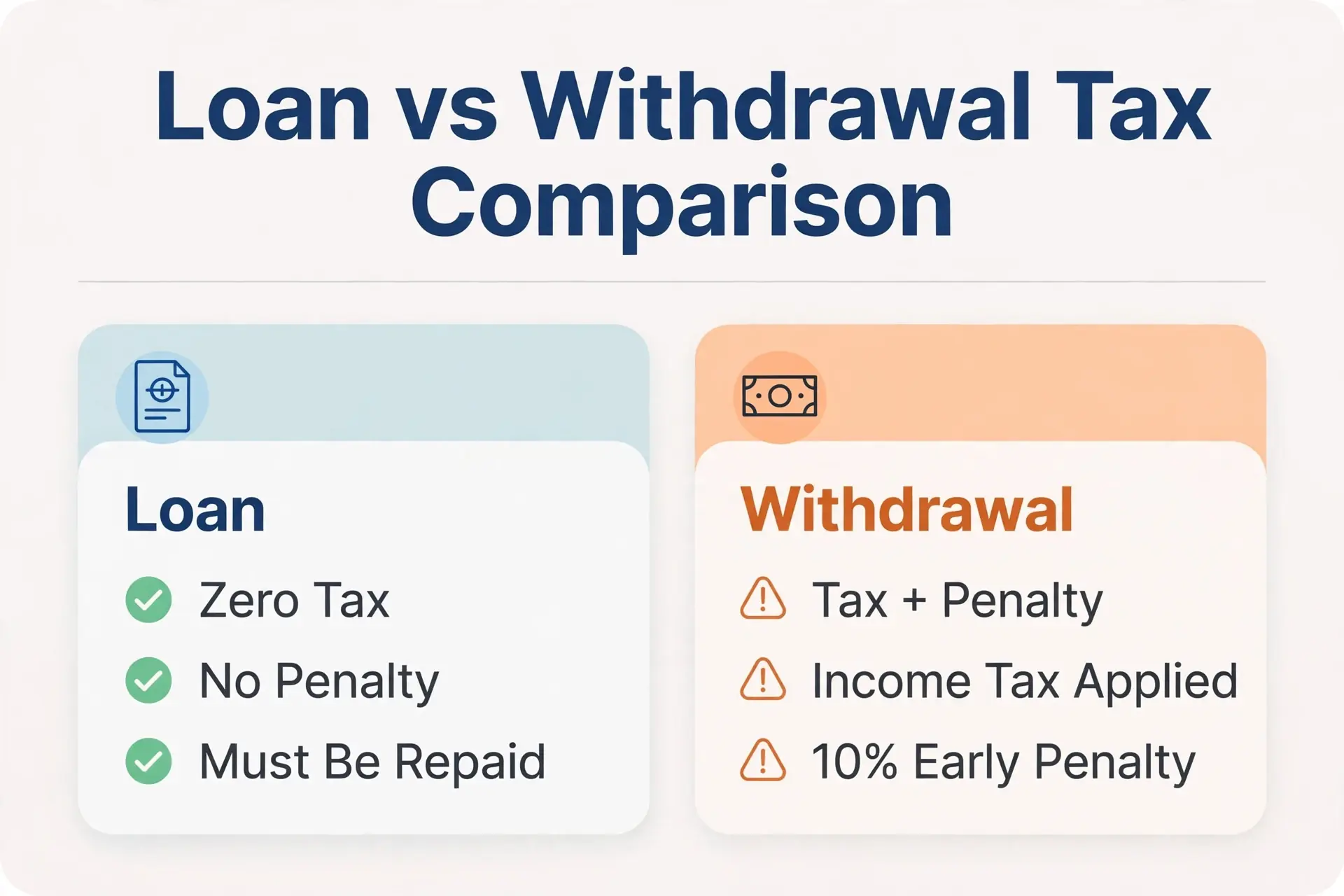
Direct answer: A TSP loan is not a taxable event unless you default, and the interest you pay goes back into your own account, according to tsp.gov. A withdrawal of the same $20,000 at a 22% federal bracket costs $4,400 in federal tax plus a $2,000 IRS 10% early withdrawal penalty, and the withdrawn amount loses $9,387 of future growth, for a withdrawal total cost of $15,787 against a loan cost of $6,609. That $6,609 is a $50 fee plus $9,387 of foregone growth, minus $2,828 of interest paid back to yourself. The $9,387 is 8% growth on $20,000 over 5 years. The $2,828 is the interest at 5.375% over 5 years.
Key Takeaways
- A TSP loan is not taxed when you take it. Tax only appears if you default, when the unpaid balance becomes a taxable distribution, according to tsp.gov.
- A Traditional TSP withdrawal is taxed as ordinary income, according to tsp.gov and the IRS, so the tax rate is your own federal bracket, plus state tax where it applies.
- The 10% early withdrawal penalty applies before age 59 and a half, unless an exception applies, according to the IRS.
- On $20,000 at a 22% bracket, the withdrawal tax bill is $4,400 plus a $2,000 penalty, and the cash you actually receive is $13,600.
- The loan side still has a real cost: $9,387 of foregone growth at the 8% assumed market return, minus $2,828 of interest paid back to yourself.
Is a TSP loan taxed?
A TSP loan is not taxed. That is the first line of the tax comparison, and it comes from tsp.gov: a loan is not a taxable event unless you fail to pay it back. The interest you pay goes back into your own TSP account, so it is not a cost paid to a lender. The only tax risk on the loan side is default. If you leave federal service and do not repay or keep the loan current, the unpaid balance can become a taxable distribution. Check your TSP separation notice for the deadline: repay the loan in full, or start direct payments by check, money order or direct debit by that date. If you miss it, the TSP declares a loan offset and reports the balance plus accrued interest as taxable income, according to the tsp.gov TSP Loans page, “Repaying after separating” section, and 5 CFR 1655.15.
What tax does a withdrawal pay?
A withdrawal pays ordinary income tax, plus a penalty if you are under age 59 and a half. Traditional TSP withdrawals are taxed as ordinary income, according to tsp.gov and the IRS, so the federal tax is your marginal bracket applied to the full amount. On $20,000 at a 22% federal bracket (an example assumption, enter your own bracket in the tool), the federal tax is $4,400. The 10% early withdrawal penalty adds $2,000. State tax depends on the state you live in, and TSP does not withhold state tax. The 9 states with no income tax are Alaska, Florida, Nevada, New Hampshire, South Dakota, Tennessee, Texas, Washington and Wyoming, verified against Tax Foundation 2026 state individual income tax rates. Michigan is not one of them: Michigan taxes income but allows a retirement and pension subtraction, up to 100% of the 2026 maximum, per the Michigan Department of Treasury, so do not treat it as exempt.
What about the tax withheld upfront?
Withholding is tax taken out of your payment before you receive it. It is not the same as the tax you owe. The withdrawal side of the comparison shows the cash you actually receive, and withholding changes that figure. The tsp.gov booklet “Tax Rules About TSP Payments” sets the rates: 20% mandatory federal withholding on an eligible rollover distribution paid directly to you, such as a lump sum, an age 59 and a half in-service withdrawal, or installments scheduled for fewer than 10 years. The second rate is 10% default federal withholding on a financial hardship withdrawal, a required minimum distribution, or certain court ordered payments, where you can elect a different rate. And the TSP withholds no state tax. Do not confuse the amount withheld upfront with your final tax bill, which is settled when you file.
The worked comparison on $20,000
The table below puts the tax cost of each choice side by side, on the same $20,000 over 5 years at the G Fund rate of 5.375% (tsp.gov, November 2026).
| Item | Loan | Withdrawal |
|---|---|---|
| Federal income tax | $0 | $4,400 (22% example bracket) |
| 10% early withdrawal penalty | $0 | $2,000 |
| Processing fee | $50 | $0 |
| Interest paid back to yourself | $2,828 | $0 |
| Foregone growth at 8% assumed return | $9,387 | $9,387 |
| Cash you receive | $19,950 | $13,600 |
| Total cost | $6,609 | $15,787 |
The loan is cheaper by $9,178. The 8% market return is an illustrative assumption, not a forecast, and you can change it in the calculator.
Frequently asked questions
Short answers to the questions people ask most are below.
- Do I have to pay taxes on a TSP loan? No. A TSP loan is not a taxable event unless you default, according to tsp.gov. The interest you pay goes back into your own TSP account.
- What tax rate applies to a TSP withdrawal? Traditional TSP withdrawals are taxed as ordinary income, according to tsp.gov and the IRS, so the rate is your own federal tax bracket, plus state tax where it applies. Before age 59 and a half, a 10% early withdrawal penalty also applies unless an exception applies.
- How much tax do I pay on a $20,000 TSP withdrawal? At a 22% federal bracket, which is an example assumption, the federal tax on $20,000 is $4,400, plus a $2,000 10% penalty if you are under 59 and a half, so you receive $13,600 in cash before state tax.
How to use the TSP loan calculator
Use the TSP loan calculator to run this tax comparison on your own numbers. Enter the amount, your federal tax bracket and your state tax bracket, your age for the 59 and a half penalty test, and whether the balance is Traditional or Roth. The comparator shows the loan side and the withdrawal side together, with federal tax, the 10% penalty, state tax, cash actually received and lost growth on the withdrawal side, and the verdict line at the top. The benefits are simple: the result is instant with no email gate, and the rate default is the current 5.375% G Fund rate from November 2026. The “what if” sliders let you change the amount, the term and the market return and watch the verdict move. For the community view of the same choice, read TSP Loan vs Withdrawal: What Reddit Gets Right.
Sources
- tsp.gov, TSP Loans page, last updated 14 September 2026: loan not a taxable event unless defaulted; Traditional withdrawals taxed as ordinary income.
- 26 U.S.C. 72(t)(1) and IRS Topic No. 558: 10% additional tax on the taxable portion of distributions before age 59 and a half, unless an exception applies.
- tsp.gov, “Tax Rules About TSP Payments” booklet: 20% mandatory federal withholding on eligible rollover distributions paid to you; 10% default withholding on hardship withdrawals, required minimum distributions and certain court ordered payments; TSP does not withhold state tax.
- 5 CFR 1655.15: loan offsets and deemed distributions when a separated participant does not repay the loan in full or begin payments by the deadline in the separation notice.
- The 9 no-income-tax states list is verified against Tax Foundation 2026 state individual income tax rates; Michigan is not exempt, it allows a retirement and pension subtraction instead.
Disclaimer: Estimates only, not financial advice. Verify with tsp.gov guidance, IRS guidance, or a qualified tax adviser.
Last verified: 16 November 2026