How Much Tax Will You Pay on a TSP Withdrawal?
A TSP withdrawal is taxed as ordinary income, and an early one can add a 10% penalty on top. The exact bill depends on your tax bracket, your state, your age, and whether the money comes from a Traditional or a Roth TSP balance. Use the TSP early withdrawal calculator to work out your own figures before you request the money.
Direct answer: A Traditional TSP withdrawal is taxed as ordinary income at your federal marginal rate, plus state tax where your state taxes it. A 10% early withdrawal penalty applies to the taxable part if you are under age 59 and a half and no exception applies, according to IRS Topic 558 and IRS Publication 575. The TSP also withholds 20% of the taxable part of an eligible rollover distribution paid to you, according to tsp.gov. But that withholding is a prepayment, not your final tax bill.
Key Takeaways
- Traditional TSP withdrawals count as ordinary income, so your marginal tax rate sets the federal part of the bill.
- A 10% early withdrawal penalty applies before age 59 and a half unless an exception applies, per IRS Topic 558.
- The TSP withholds 20% of an eligible rollover distribution paid to you, per tsp.gov, but your real bill can be higher or lower.
- State tax depends on where you live. The nine states with no broad-based individual income tax in 2026 are Alaska, Florida, Nevada, New Hampshire, South Dakota, Tennessee, Texas, Washington, and Wyoming, per Tax Foundation 2026 state income tax rates. Fourteen more states exempt some retirement income, from full exemption in Illinois, Mississippi, Pennsylvania, and Iowa to capped exclusions elsewhere, each listed with its state tax agency source in our state post.
How much tax will you pay on a TSP withdrawal?
You pay federal income tax at your marginal rate on the taxable part, plus state tax if your state taxes it. You also pay a 10% penalty if you are under 59 and a half and no exception applies.
Your federal tax is the taxable part of the withdrawal times your marginal rate. A withdrawal can also push some of your income into a higher bracket. So the rate on the last dollars can be higher than the rate on the first dollars.
State tax is separate. Some states tax retirement withdrawals as ordinary income and some do not. The nine states with no broad-based individual income tax in 2026 are Alaska, Florida, Nevada, New Hampshire, South Dakota, Tennessee, Texas, Washington, and Wyoming, per Tax Foundation 2026 state income tax rates. Fourteen more states exempt some retirement income, each listed in our state post with its state tax agency source. Check that list before you rely on a state figure.
| Part of the bill | What sets it | Source |
|---|---|---|
| Federal income tax | Your marginal tax rate | IRS |
| State income tax | Your state of residence | State tax agency, check before you rely on it |
| 10% early withdrawal penalty | Age under 59 and a half, no exception | IRS Topic 558 and IRS Publication 575 |
| 20% withholding | Eligible rollover distribution paid to you | tsp.gov |
What does the worked example show?
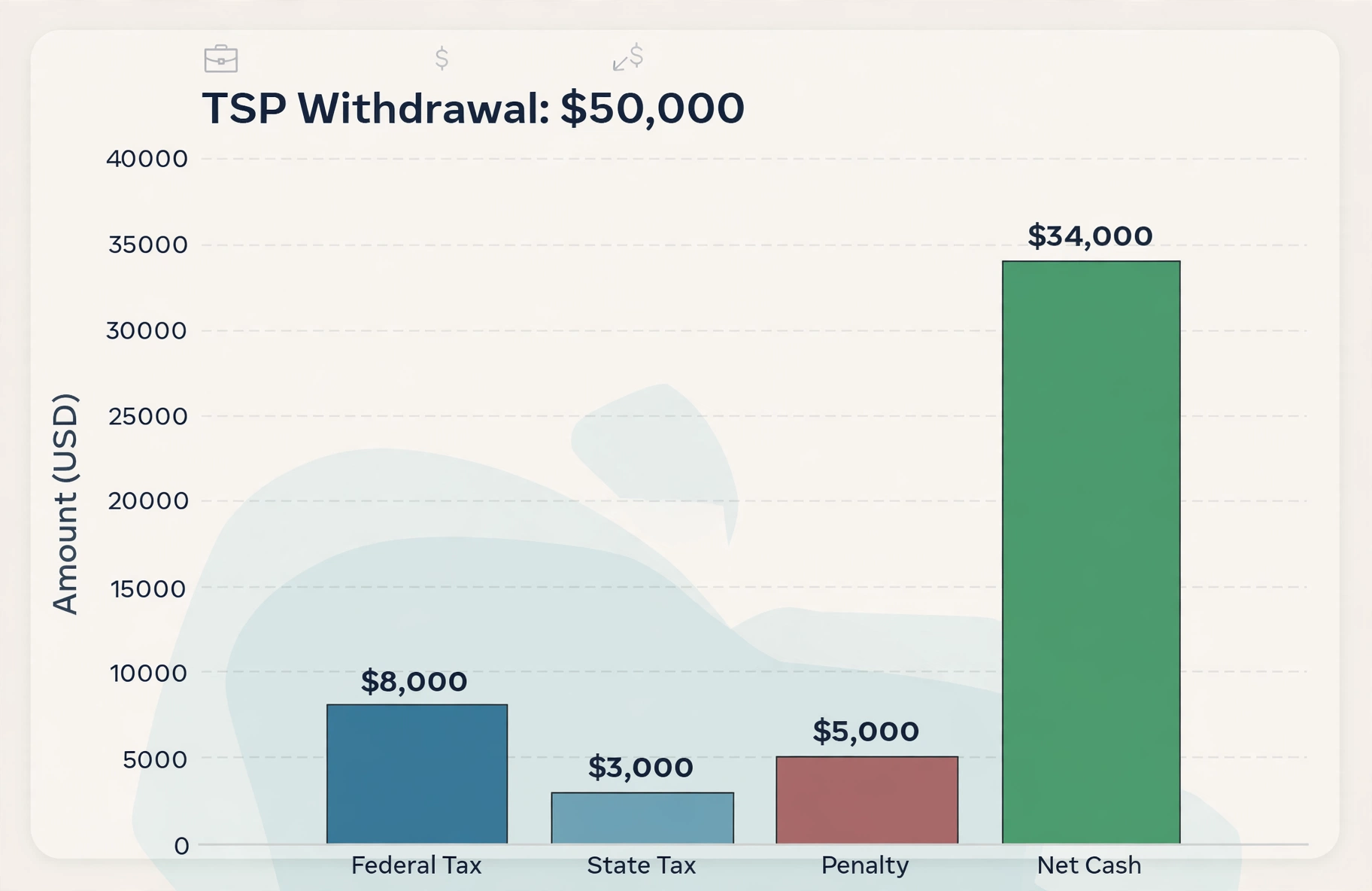
On an illustrative $50,000 Traditional TSP withdrawal at age 58 with no age 55 exception, the total cost is $19,500 and the net cash is $30,500.
Here is the same example worked out line by line, using IRS Publication 575 and tsp.gov rules: 24% federal tax is $12,000, 5% state tax is $2,500, and the 10% penalty is $5,000. That adds to $19,500, leaving $30,500 in hand. The arithmetic checks out: 24% of $50,000 is $12,000, 5% is $2,500, and 10% is $5,000. The 10% penalty is per IRS Topic 558 and the 20% withholding is per tsp.gov. The 24% federal and 5% state rates are illustrative assumptions, not your rates. Use them as a worked illustration and check your own numbers with the calculator.
The same $50,000 with the age 55 separation rule applying gives $14,500 total and $35,500 net, a saving of $5,000, because the penalty drops away. That one rule is worth checking before any early withdrawal.
Does the 20% withholding mean you owe 20%?
No. The 20% is a prepayment toward your tax bill, and the gap between it and your real bill is settled when you file your return.
If your real federal rate on the withdrawal is lower than 20%, you get some of the withholding back. If it is higher, you owe the rest at tax time. The calculator shows this gap so the amount that lands in your bank account does not fool you into thinking the tax is settled.
Hardship withdrawals are different. They carry a default 10% federal withholding, according to tsp.gov guidance, and you can elect a different amount. A hardship withdrawal does not by itself avoid the 10% penalty, because hardship is not among the exceptions in IRS Topic 558. So the penalty still applies before age 59 and a half unless a separate exception applies, per IRS Topic 558 and IRS Publication 575.
Frequently asked questions
How much will my TSP withdrawal be taxed?
A Traditional TSP withdrawal is taxed as ordinary income at your marginal rate, plus state tax where it applies, and a 10% penalty applies before age 59 and a half unless an exception applies, per IRS Topic 558. Use the TSP early withdrawal calculator to work out your own bill.
How much tax and penalty will I pay on an early TSP withdrawal?
On an illustrative worked example, a $50,000 Traditional withdrawal at age 58 with no age 55 exception costs $19,500 in tax and penalty and leaves $30,500. Your own bill depends on your bracket, your state, and your age.
How to use the TSP early withdrawal calculator
Open the TSP early withdrawal calculator and enter $50,000 as the withdrawal, 58 as your age, and Traditional TSP as the balance type. Then add that you separated before the year you turned 55 so the age 55 test comes back negative. The result shows $12,000 of federal tax at a 24% rate, $2,500 of state tax at 5%, a $5,000 penalty, $10,000 of withholding, and $30,500 of net cash, so you can see the whole bill on the same screen.
Change the separation year to the year you turned 55 and watch the penalty line fall to zero and the net cash rise to $35,500, which shows exactly what that one rule is worth on your figures.
If a loan looks cheaper than paying $19,500 on a $50,000 withdrawal, compare the two on the TSP loan calculator.
Read more in the same cluster: How Much Tax Do You Pay If You Withdraw Early From TSP?.
Sources
- IRS Topic 558, Additional Tax on Early Distributions From Retirement Plans Other Than IRAs (10% penalty and exceptions).
- IRS Publication 575, Pension and Annuity Income (age 55 separation rule).
- tsp.gov, Changes to Tax Rules About TSP Payments (20% mandatory withholding).
- Tax Foundation, 2026 state income tax rates (nine states levy no broad-based individual income tax: Alaska, Florida, Nevada, New Hampshire, South Dakota, Tennessee, Texas, Washington, Wyoming).
- State tax agencies, via the state list in What States Do Not Tax TSP Withdrawals (Illinois, Mississippi, Pennsylvania, Iowa, Alabama, Hawaii, New York, New Jersey, Georgia, Colorado, Arkansas, Delaware, Virginia, South Carolina).
Disclaimer: Estimates only, not financial advice. Confirm the tax figures for your own withdrawal on tsp.gov and IRS guidance, or with a qualified tax adviser, before you act.
Last verified: 16 November 2026